Case Study · Enterprise Tax Software · NDA

Designing for
High-Stakes Simplicity

Reducing cognitive load and filing errors across two enterprise tax platforms — for users ranging from first-time individual filers to professional accounting firms.

Role
Sole Designer
Agile Cell · 2 Products
Scale
100K+
users
Rejections reduced
45%
fewer filing errors
Screens condensed
30→8
state tax flows
01

Project framing

Two products, one high-stakes domain — both operating under the same constraint: errors have real financial consequences.

Phase 01 — Consumer Tax Platform

I joined in January — peak U.S. tax season — as the lead UX/UI designer within a cross-functional agile cell. The product was an established consumer platform serving 100K+ individual filers. With users actively completing their returns, it was the highest-signal research window of the year.

User interviews ran throughout tax season — active filers recruited with Amazon gift cards for 20-minute sessions. I participated as note-taker, observing users navigate real flows with real money on the line.

Phase 02 — Professional Tax Software

The second engagement was a legacy platform built for professional accounting firms — CPAs and tax preparers managing hundreds of client returns daily. A phased redesign was underway. My role was to extend the established system into new areas: self-serve purchase flows, CPE training enrollment, and compliance workflows that previously required a support call.

Phase 01 — Consumer Context
  • First-time filers: no domain knowledge, high anxiety, zero margin for unclear instructions
  • Returning users: expected the platform to remember their prior-year data
  • Seniors: required predictable step-by-step flows — cognitive overload was a real barrier
  • Errors have financial consequences — a rejected return delays refunds by weeks
Phase 02 — Professional Context
  • CPAs and tax preparers — expert users with high task frequency
  • Firms purchasing returns in volume — previously required a support call
  • CPE compliance training — purchased and tracked through the platform
02

When confusion has consequences

Tax software isn't a productivity tool — it's a compliance tool. A confusing UX doesn't cost users time. It costs them money.

In Phase 01, users entering their AGI and IP PIN had no real-time validation — if values were wrong, the return was submitted and rejected by the IRS days later, with no clear resolution path. Meanwhile, state-level tax flows had grown to 30+ screens with no conditional logic.

In Phase 02, the friction was commercial: accountants wanting to purchase additional returns or enroll in CPE courses had to call support to complete those transactions. Every support call was a broken self-serve experience.

"Confusion in this domain doesn't cost the user time — it costs them money."
Consumer · 01

No AGI/IP PIN validation — errors only surfaced after IRS rejection, days after submission

Consumer · 02

30+ screen state flows with no conditional logic — redundant questions, high drop-off

Professional · 01

License and return purchases required a support call — no self-serve path existed

Professional · 02

CPE course enrollment was fragmented — no unified purchase flow for training

03

Learning from live filers

The research window was narrow and irreplaceable — users actively filing returns, with real stakes and fresh recall.

Phase 01 — Research Methods
  • Live interviews with active filers during tax season — incentivized with Amazon gift cards
  • Note-taking during sessions — capturing hesitations, errors, and confusion in real time
  • Roadmap alignment to connect field observations with planned feature work
  • Flow audits of state-level sequences to map redundancy and conditional gaps
Phase 02 — Research Methods
  • Support ticket analysis to identify transactions driving inbound calls
  • Existing design system review before extending patterns to new areas
  • Stakeholder sessions to map CPE and licensing requirements
Key Insights
  • Users didn't know their AGI — they expected the platform to know it, especially returning filers
  • Post-rejection error messages were opaque — users had no path to self-resolution
  • Many state flow screens were structurally identical — duplicated rather than reused
  • Professional users wanted to manage their own licenses — the support call was a workaround, not a preference
  • CPE and next-year product purchases were adjacent decisions users wanted to handle together
04

As-is workflow

Errors surfaced long after users had left the product. Purchases required leaving the product entirely.

Consumer — AGI / IP PIN · Before
User Enters
AGI / IP PIN
No Validation
accepts anything
Return Submitted
to IRS
IRS Rejection
days later
Opaque Error
no recovery path
Unvalidated input
Deferred error — no recovery
Professional — License Purchase · Before
CPA Needs Returns
No Self-Serve Path
in product
Calls Support
wait time
Manual Process
by agent
License Updated
No self-serve path
Support call required for routine purchase
05

Strategic reframe

The real problem wasn't missing features — it was that both products treated high-stakes compliance workflows like form builders.

From
Patching individual features on existing tax products
To
Reducing cognitive load and friction in high-consequence compliance flows — for users of all levels
Move validation upstream — catch errors at input, not after IRS rejection
Apply conditional logic — only show what's relevant to each user's profile
Replace every support-call-required transaction with a self-serve flow
06

To-be workflow

Validation moved upstream. Purchases moved in-product. Both workflows now close where they should.

Consumer — AGI / IP PIN · After
IRS Account Link
returning users
AGI Pre-filled
saved data
Inline Validation
real-time
Submitted
validated
IRS Accepted
45% fewer rejections
Validation at point of input
Data persistence for returning users
Professional — License Purchase · After
CPA Needs Returns
Self-Serve Flow
in-product
Volume Selection
+ next year option
Checkout
no support call
License Active
Full self-serve purchase
Support call eliminated for standard volumes
07

Design execution

Zero tolerance for ambiguity in a high-consequence flow.
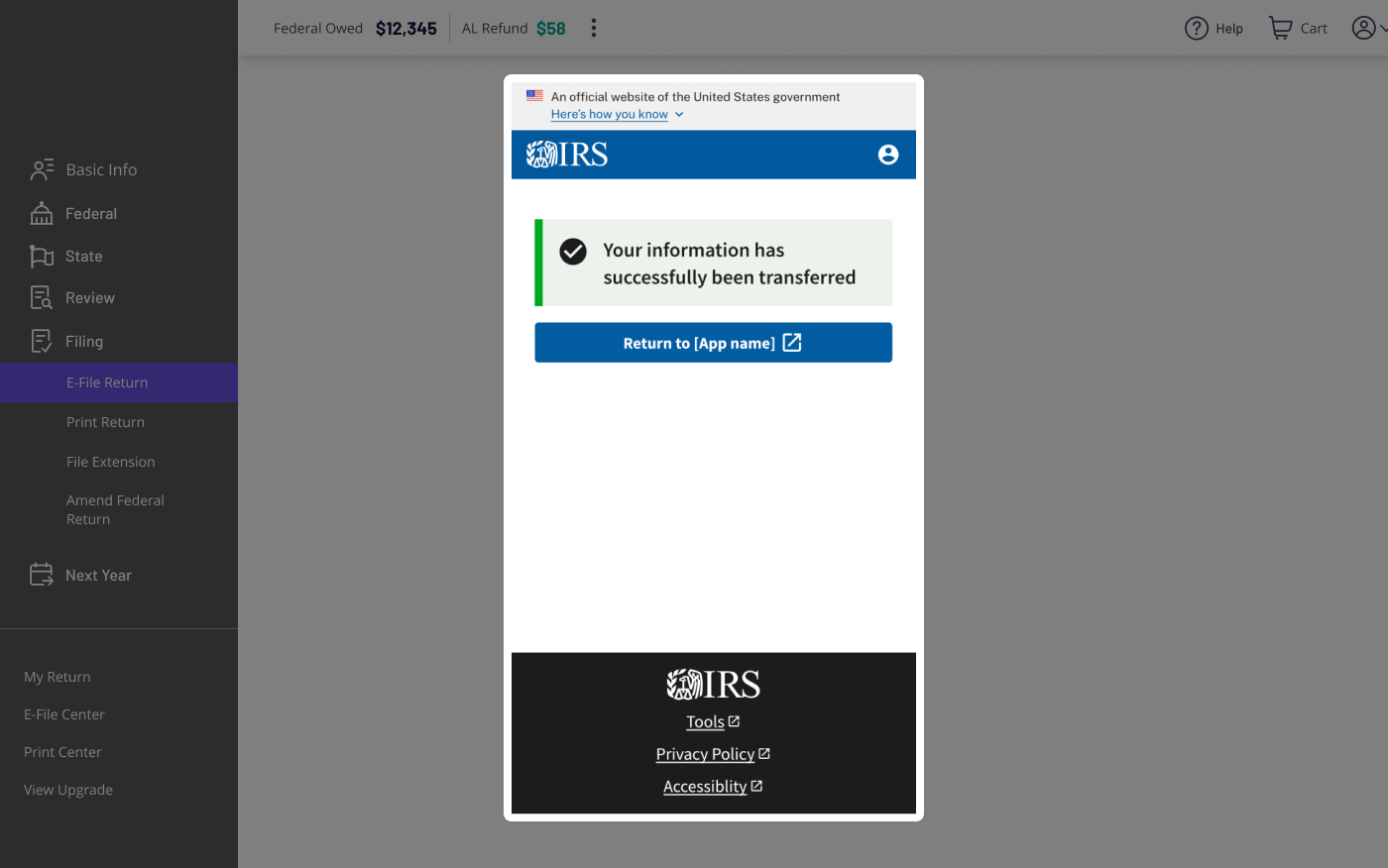
Consumer Platform — AGI/IP PIN inline validation
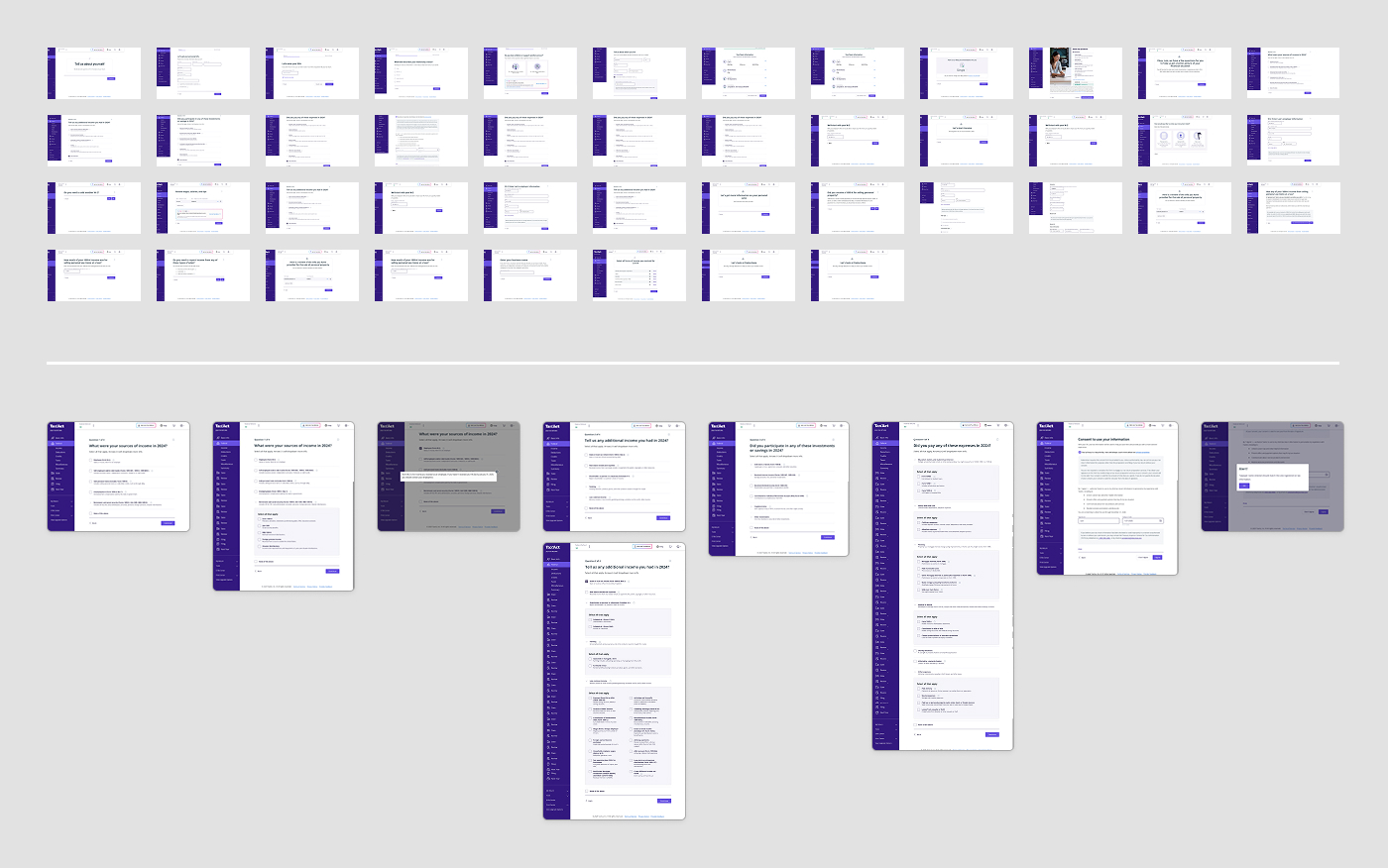
Consumer Platform — Condensed state flow
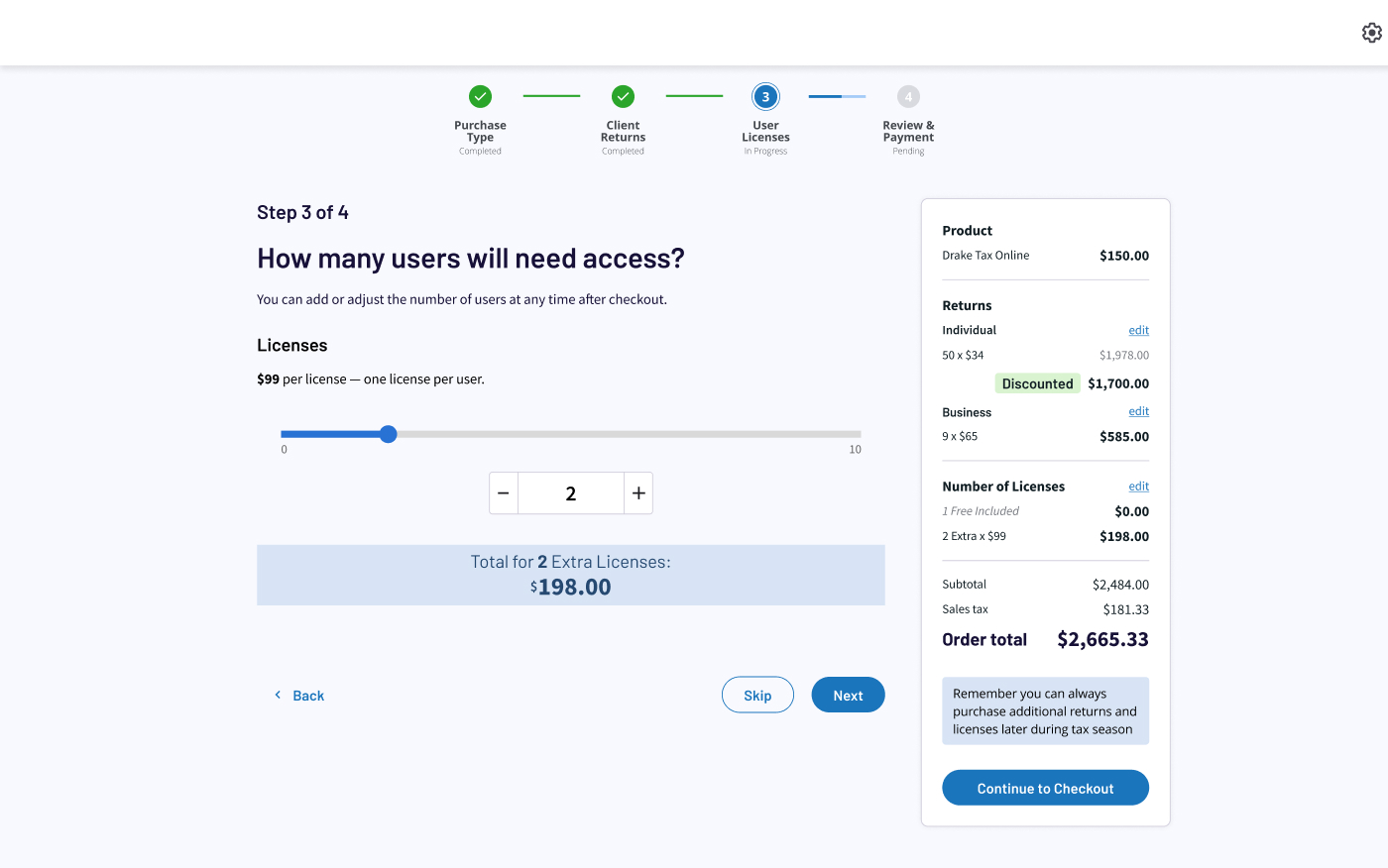
Professional Platform — Self-serve license purchase
01
Inline Validation at Point of Entry

AGI and IP PIN fields validate against IRS data in real time — surfacing errors immediately before the user advances. For returning users, AGI is pre-populated from saved data, eliminating the primary source of filing rejections.

02
Conditional Flow Architecture

State-level flows restructured with branching logic — only screens relevant to each user's profile are shown. Shared patterns reused across states reduced 30+ screen sequences to 7–8 without losing compliance coverage.

03
Self-Serve License & Returns Purchase

Professional users select return volume, add current-year and next-year licenses in a single transaction, and complete checkout independently. Support calls reserved for high-volume enterprise deals.

04
CPE Training & Schools Enrollment

Redesigned course discovery and purchase flow for CPE certifications and in-person training — giving professional tax preparers a unified path to manage continuing education compliance.

08

Results & impact

Results across filing accuracy, flow efficiency, and commercial self-sufficiency.

45%
Fewer Filing Rejections

IRS API validation eliminated AGI/IP PIN errors at the source — before submission reached the IRS.

30→8
Screens Reduced

State compliance flows condensed through conditional logic and pattern reuse — zero compliance requirements lost.

Zero
Support Calls

Standard license and return purchases moved fully to self-serve — no agent required for any standard volume transaction.

09

Designing for AI readiness

How the design decisions made today create the foundation for AI-augmented tax assistance tomorrow.

01
Structured Input as Training Signal

The shift from free-form entry to validated, typed fields creates clean structured data — the foundation for pattern detection. Identifying common error types and drop-off signals across 100K+ users becomes tractable when input is machine-readable.

02
Conditional Logic as the Foundation for Personalization

The branching system built for state flows is architecturally identical to what a recommendation engine needs. The logic layer deciding which screens to show could evolve into an AI-assisted system adapting flows based on user profile and filing history.

03
User Diversity as an AI Opportunity

Designing for users from 18 to 75+ means the system already accommodates vastly different domain knowledge levels. AI-generated contextual guidance could surface exactly when and for whom it's needed — invisible to confident filers.

What AI Could Augment — Without Replacing Compliance
AI as a guidance layer — reducing cognitive load for users who need it, invisible for those who don't.
10

Reflection & key takeaways

Working in a high-consequence domain raises the bar for what "clear" actually requires.

Errors must be caught where they can still be fixed.

Deferred validation isn't just bad UX — it's a broken trust contract. The design principle: surface errors where users still have agency to act on them.

Cognitive load is the real accessibility issue.

For a 68-year-old filing taxes for the first time, the biggest barrier is a 30-screen flow with questions they don't understand. Simplicity is the deepest form of accessibility here.

Research during peak season is irreplaceable.

Interviewing users while actively filing — with real money on the line — produces insight no post-hoc research can match. The timing was a design decision in itself.

A support call is a design failure in disguise.

Every time a professional user had to call to purchase returns or enroll in training, that was an unfinished flow. Completing those flows was as much a UX intervention as any consumer-facing improvement.

NDA · Confidential

This project was completed under NDA — client names and visual artifacts are withheld. Screenshots available upon request with brand elements removed. Metrics reflect estimates based on available data and 2025 tax season benchmarks.

Next case study
Enterprise LMS & AI Learning
View case study