Case Study · Enterprise LMS · AI-Powered Learning · NDA

The Feature That
Closed the Deal

Designing AI-powered practice and translation workflows for an enterprise learning platform — shipping the feature that secured a major airline client and cutting course build time nearly in half.

Role
Sole Designer
Agile Cell · 4-designer team
Timeline
3+ years
Jun 2021 – Jul 2024
Learner engagement
+40%
Practice module
Course build time
½
AI translation
01

Project framing

Three years of continuous product evolution — shipping features that measurably improved learning outcomes and directly contributed to closing a major strategic deal.

The platform was an enterprise-grade e-learning system — combining expert-led content, AI-powered feedback, and personalized learning paths for corporate and institutional clients.

I was the UX design owner for my dedicated product cell — part of a broader 4-designer team across the platform, working end-to-end across research, wireframes, prototyping, and handoff. Over three years, I shipped features across multiple areas — with two becoming strategically critical: the AI-powered Practice module and the AI translation workflow.

Additional Scope
  • Analytics Dashboards — real-time performance data for platform administrators
  • Mobile App — learner-first mobile experience for video practice on-the-go
  • Usability improvements — ongoing iteration on content creation, navigation, and learner journeys
Platform Context
  • Blended learning model — self-paced, live, and AI-assisted modalities
  • Three user roles: Learners, Instructors, Administrators — each with distinct goals
  • Enterprise clients across multiple industries — requiring scalable design
  • Desktop-first with strong mobile usage among learners
  • AI integration at two layers: learner feedback (Practice) and content production (Translation)
02

Two failures, same root

One was a feedback quality problem. The other was a production bottleneck. Both were solved by putting AI in the right place.

Problem 01 — Practice Feedback

The Practice feature let learners record video or audio responses, then receive peer and instructor feedback. In theory, high-value skill-building. In practice, giving feedback was itself a graded activity — and learners fell into a pattern of surface responses ("great job, keep it up") to satisfy the requirement and move on. The feedback loop that was supposed to drive improvement had become a checkbox.

"When feedback becomes a task to complete, it stops being feedback."
Problem 02 — Course Translation

Enterprise clients with global learner bases needed courses in multiple languages. The process was entirely manual — coordinating translators, reformatting content, validating outputs — stretching production timelines to 5–6 weeks per localization cycle.

This was on the roadmap. But when a major airline client signaled that an integrated translation workflow was their condition for signing, it stopped being a roadmap item and became a priority.

03

Understanding the loops

Research surfaced the behavioral root of the feedback problem — and defined what good AI integration would look like.

Research Approach
  • User interviews with learners, instructors, and admins — understanding feedback behavior across all roles
  • Stakeholder workshops via Productboard to gather and prioritize feature ideas
  • AI platform research — evaluating speech analysis, tone recognition, key phrase detection
  • Third-party translation tool evaluation — assessing API capabilities and integration complexity
  • Usability testing with prototypes — multiple rounds before shipping
Key Insight — Practice

AI feedback needed to be immediate and objective. Human peer feedback arrived late, was inconsistently useful, and had become performative. AI insights on speech speed, tone, and key phrases arrived the moment a learner finished recording — and that immediacy changed behavior: learners re-practiced because the feedback was actionable right now.

What the Research Revealed
  • Feedback quality dropped sharply when tied to graded completion — incentive structure was the root cause
  • Learners wanted to improve but needed immediate, specific, actionable signals
  • Instructors spent disproportionate time reviewing submissions that didn't need their attention
  • Translation was the single biggest production bottleneck for enterprise content teams
  • Admins needed visibility into translation status — not just the output
04

As-is workflow

Feedback arrived too late to drive re-practice. Translation required weeks of manual coordination.

Practice Loop — Before
Learner Records
video / audio
Submits
for review
Waits for Peers
delayed, variable
Generic Feedback
"great job" pattern
No Re-Practice
loop broken
Delayed feedback
Incentive misalignment — feedback as checkbox
Course Translation — Before
Content Ready
External Translator
manual coordination
Reformatting
manual rework
Validation Cycles
review rounds
Published
5–6 weeks
5–6 week cycle per language
No in-platform visibility
05

Strategic reframe

AI wasn't a feature to add — it was the missing layer that made existing workflows actually work.

Strategic Signal
"If you have this feature, I'll sign the deal."

A major airline client made AI-powered translation a condition of signing. The feature moved from roadmap to priority — designed, prototyped, demoed, and shipped to close the contract.

From
Adding AI as a feature layer on top of existing flows
To
Using AI to fix the behavioral and operational loops that human-only workflows couldn't sustain
Replace delayed peer feedback with instant AI insights — shifting learner behavior from passive to active
Embed translation into the content workflow — making localization a platform capability, not a manual process
Design AI as a silent collaborator — visible enough to be trusted, invisible enough to stay out of the way
06

To-be workflow

AI inserted at the moment of highest impact — immediately after a learner records, and at the start of the translation pipeline.

Practice Loop — After
Learner Records
video / audio
AI Analysis
instant
Specific Insights
speed, tone, phrases
Re-Practice Now
+40% engagement
Peer + Instructor
enriched context
AI feedback at point of completion
Immediate actionability drives re-practice
Course Translation — After
Content Ready
Select Language
in-platform
AI Translation
third-party API
Admin Review
progress visible
Published
3–4 weeks
5–6 weeks → 3–4 weeks
In-platform, no manual coordination
07

Design execution

Designing AI into the experience — not on top of it.
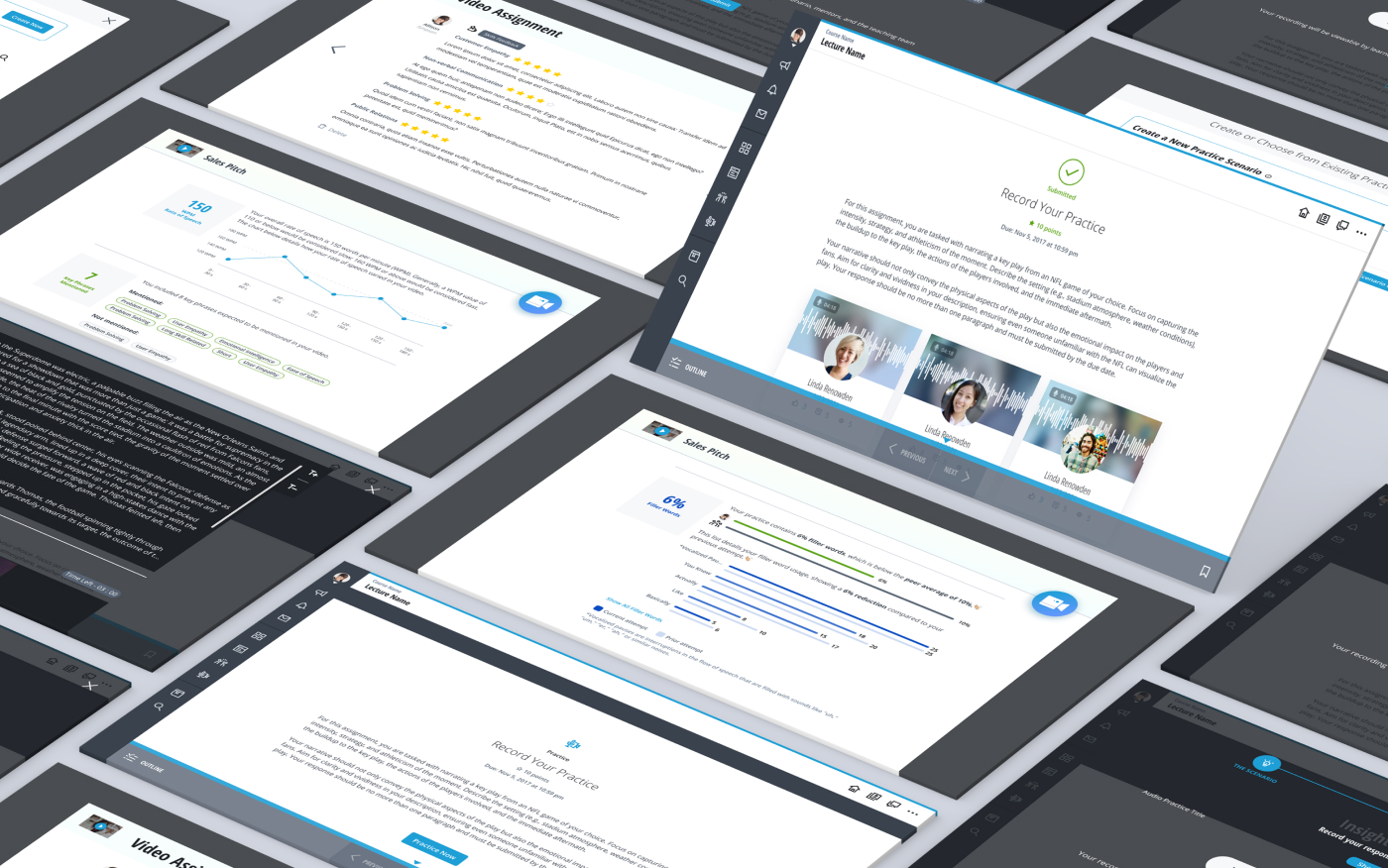
Practice module — AI insights post-recording
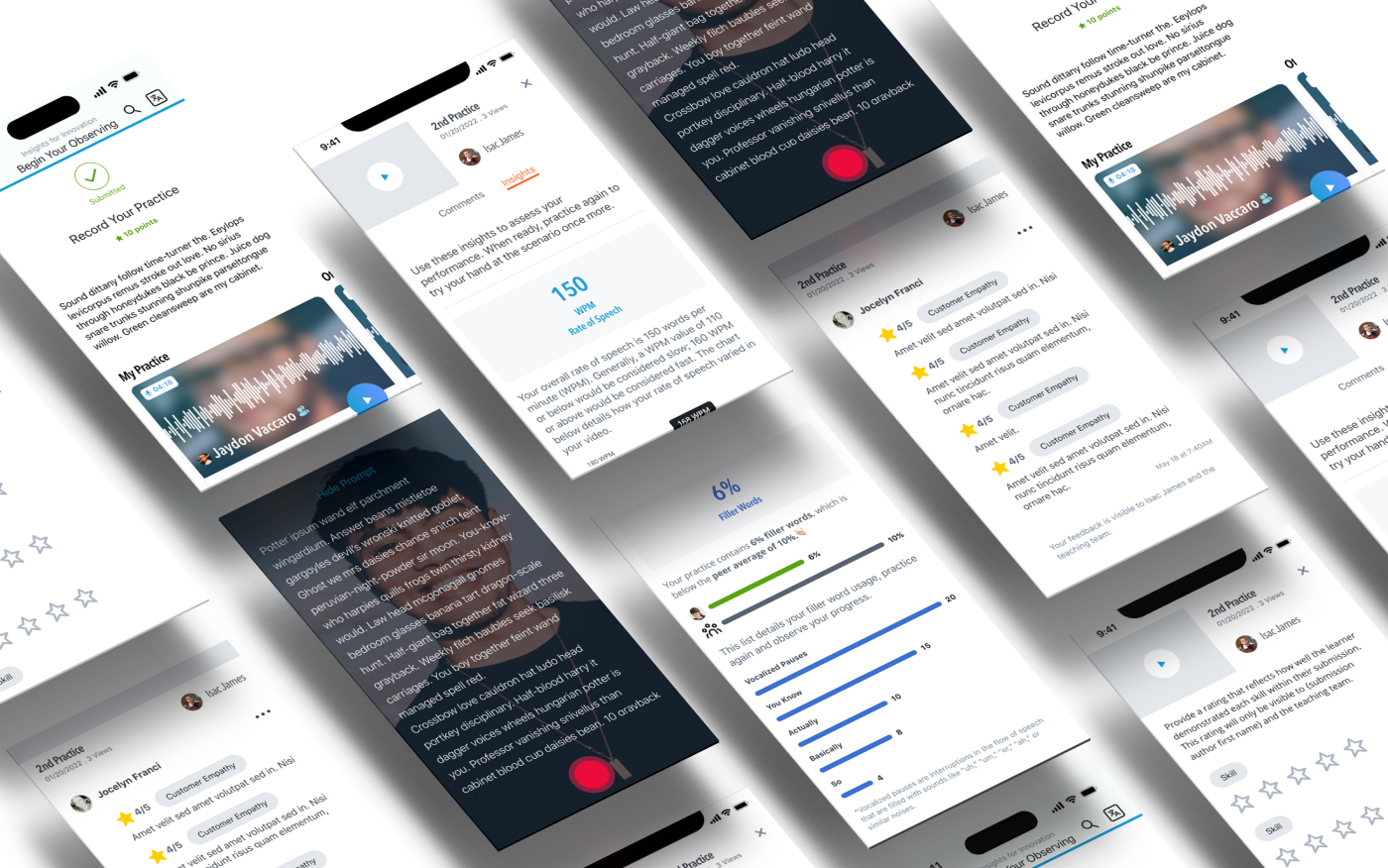
Mobile Practice flow — recording and AI insights
01
AI Insights — Immediate & Specific

Post-recording view surfaces AI analysis the moment a learner finishes — speech speed, tone, and key phrase usage displayed as actionable signals, not scores. The goal: make improvement feel possible right now, not after waiting for peer feedback.

02
Mobile-First Practice Flow

Learners overwhelmingly preferred practicing on mobile. Designed an end-to-end mobile flow — prompt display, recording interface, submission, and AI insights review — optimized for one-handed use and low-bandwidth environments.

03
AI Translation Workflow

Designed the in-platform translation flow for admins — selecting target languages, initiating AI translation via third-party API, tracking progress, and reviewing outputs before publishing. The workflow that secured the airline deal.

04
Analytics Dashboard

Admin-facing dashboards providing real-time visibility into learner performance, course participation, and engagement metrics — enabling data-driven course adjustments and targeted interventions.

08

Results & impact

Engagement improved, production accelerated, and a strategic deal was closed.

+40%
Learner Engagement

AI insights drove immediate re-practice — measurably increasing active engagement with the Practice module.

½
Course Build Time

AI translation reduced localization cycles from 5–6 weeks to 3–4 weeks — nearly cutting production time in half.

1
Strategic Deal Closed

A major airline client signed after the Practice AI feature was demoed — named as the deciding factor.

09

Designing for AI readiness

Shipping AI features in production taught me things no conceptual framework could.

01
Immediacy Is the Feature

The AI insights weren't more accurate than a good instructor — they were faster. In behavioral loops, timing matters more than precision. Instant mediocre feedback drives more improvement than delayed excellent feedback, because it arrives when motivation is highest.

02
AI Needs a Human Review Layer

The translation workflow included a deliberate review step before publishing — not because the AI was unreliable, but because the platform's credibility depended on human oversight. AI accelerates; humans validate.

03
Tone Is a Design Decision, Not a Copy Decision

How AI feedback was framed — as coaching rather than grading — was the single most important design decision in the Practice feature. The same insight, framed as a score vs. a suggestion, produces completely different learner responses. AI tone is UX.

What I'd Push Further With Today's AI Capabilities
The best AI UX is the one learners don't notice — they just notice they're getting better.
10

Reflection & key takeaways

Long-term product ownership — not sprints, but years — changes how you think about design decisions.

Behavioral design is harder than visual design.

The feedback quality problem wasn't a UI problem — it was an incentive structure problem. Fixing it required understanding why people behave the way they do, not just what they say they want.

The right feature at the right time can close a deal.

Shipping the translation workflow in response to a client's explicit requirement — and demoing it successfully — showed me that design speed and strategic alignment can be a direct revenue lever.

AI works best when it removes friction, not when it adds capability.

The most effective AI interventions weren't new features — they replaced things that weren't working. AI fixed the feedback loop. AI fixed the translation bottleneck. It solved problems, not just added tools.

Long-term ownership builds intuition no research can shortcut.

Three years on one product means you've seen decisions play out two quarters later. That accumulated context is a design asset that sprint-based work can't replicate.

NDA · Confidential

This project was completed under NDA — client and platform names are withheld. Screenshots available upon request with branding removed. Metrics based on platform analytics from the 2021–2024 engagement period.

Next case study
MaaS / Edge Infrastructure
View case study